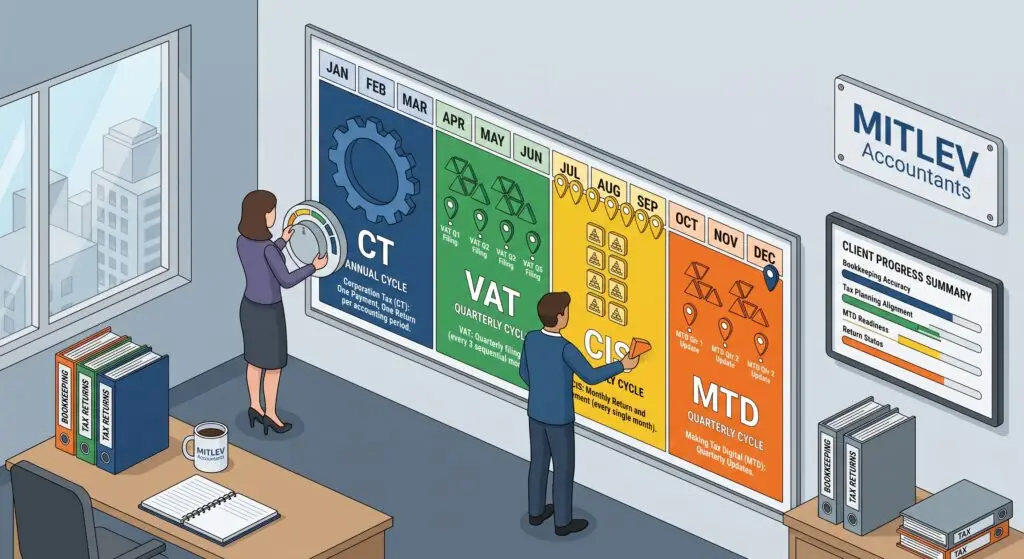


Tax deadlines have a habit of coming around quickly. Some only arise once a year, while others – such as VAT, PAYE and CIS – can come around every month or quarter.
With Making Tax Digital now also bringing quarterly reporting requirements to certain sole traders and landlords, keeping on top of deadlines is becoming increasingly important.
Here are some of the main recurring tax deadlines to be aware of.
Corporation Tax
For most limited companies, there are two Corporation Tax deadlines:
- Corporation Tax payment: 9 months and 1 day after the end of the accounting period
- Corporation Tax return: 12 months after the end of the accounting period
One point which can easily be overlooked is that the tax is actually due before the tax return filing deadline.
For example, if your company’s year end is 31 March 2026, the Corporation Tax would normally need to be paid by 1 January 2027, even though the Corporation Tax return itself is not due until 31 March 2027.
This is one reason we always encourage businesses to get their accounts prepared early. It gives you plenty of warning of the tax bill rather than finding out shortly before it needs to be paid.
What about larger companies?
Larger companies can fall within the Quarterly Instalment Payment (QIP) regime, meaning Corporation Tax is paid in instalments rather than in one payment after the year end.
The exact rules depend on the company’s level of taxable profits and whether it is part of a group, so businesses approaching these thresholds should take advice in advance.
VAT
For most VAT-registered businesses, the deadline for submitting a VAT return and paying the VAT is one month and seven days after the end of the VAT period.
For example, a VAT quarter ending 30 June would normally have a filing and payment deadline of 7 August.
With most businesses filing VAT returns quarterly, good bookkeeping throughout the year makes a big difference. Trying to bring three months of records up to date a few days before every VAT deadline is both stressful and much more likely to result in mistakes.
Construction Industry Scheme (CIS)
Businesses operating under CIS have even more regular deadlines.
Contractors generally need to submit their monthly CIS return by the 19th of each month, covering payments made to subcontractors in the previous CIS tax month.
CIS deductions are generally payable to HMRC by the 22nd of the month when paying electronically, or the 19th when paying by post.
Because this happens every month, it is particularly important that subcontractor records and payments are kept up to date.
Making Tax Digital – A New Quarterly Deadline
Making Tax Digital for Income Tax (MTD) is now becoming relevant for a growing number of sole traders and landlords.
From 6 April 2026, self-employed individuals and landlords with qualifying income of more than £50,000 are required to keep digital records and submit quarterly updates to HMRC.
The quarterly update deadlines are:
- 7 August
- 7 November
- 7 February
- 7 May
The £50,000 threshold will also reduce in future years, meaning considerably more taxpayers will eventually be brought into MTD.
Importantly, submitting quarterly information does not mean paying Income Tax every quarter. The normal tax payment timetable continues to apply.
If you are affected, however, waiting until January to sort out a year’s worth of bookkeeping is no longer going to work. Records will need to be kept up to date throughout the year.
Why We Always Recommend Starting Early
A tax deadline should really be the latest date something gets done, not the target date.
Preparing accounts and tax returns earlier gives business owners a much clearer picture of what they owe and, crucially, more time to plan for the payment.
It can also give your accountant time to identify tax planning opportunities while there is still time to actually do something about them.
Leaving everything until the last minute can mean missed reliefs, bookkeeping errors, unexpected tax bills and, if the deadline is missed altogether, penalties and interest.
Stay Ahead of Your Deadlines
At MITLEV Accountants, we don’t believe clients should have to remember every HMRC deadline themselves.
We help businesses stay on top of their accounts, Corporation Tax, VAT, CIS and other ongoing filing requirements – and wherever possible, we aim to deal with things well before the deadline rather than at the last minute.
If you’re unsure about an upcoming tax deadline or whether Making Tax Digital will affect you, get in touch with MITLEV Accountants and we’ll be happy to help.